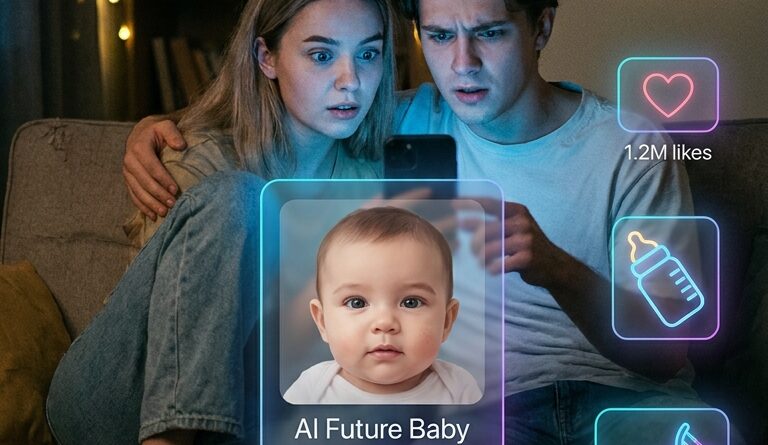
Inside TikTok’s ‘AI Time Capsule Baby’ Wave: How Future‑Face Filters Quietly Became Gen Z’s New Way To Test‑Drive Adulthood
You are not imagining it. The TikTok AI future baby filter trend is everywhere, and it can feel weirdly intense for something that starts with two selfies and a tap. One second it is a joke. The next, a couple is staring at an AI-generated toddler like they just skipped five years of dating and landed in a family group chat. That mix of cute, creepy, and emotionally loaded is exactly why this trend has caught on. For Gen Z in particular, these filters are doing more than making content. They are becoming a low-stakes way to test chemistry, signal commitment, laugh about future plans, and poke at real anxieties around love, fertility, money, and timing. It is playful on the surface. Underneath, it says a lot about how online culture now lets people rehearse big life milestones before they are ready to live them for real.
⚡ In a Hurry? Key Takeaways
- The TikTok AI future baby filter trend is less about accurate genetics and more about relationships, identity, and trying on adulthood in public.
- If you want to join the trend, add your own angle. Talk about privacy, expectations, or the joke behind it instead of copying the same reveal clip.
- These tools often require face data, so think before uploading selfies, especially of both partners, and avoid treating the result like anything factual.
Why this trend hit such a nerve
At a basic level, the format is irresistible. Two people upload photos. The app spits out a baby face. Everyone reacts. It is fast, emotional, and easy to understand even with the sound off.
But the real reason the tiktok ai future baby filter trend keeps spreading is that it gives people a shortcut to a huge life question. Not “Do we look cute together?” More like, “Can I picture a future with you?” That is a big leap for a goofy filter, yet that is exactly what makes it so sticky.
For some couples, it is flirting with training wheels. For others, it is a joke that doubles as a soft relationship check-in. And for solo viewers, it is catnip. You are not just watching an AI trick. You are watching people audition a version of adulthood.
It is not really about babies
This is the part worth slowing down for. Most people using these filters do not actually believe the app can predict what a real child would look like. They know it is synthetic. They know it is just guessing based on facial features, beauty standards, and whatever training data sits behind the tool.
Still, the emotional reaction is real.
That is because the output acts like a prop. It helps people talk around things that can feel awkward to say directly. Marriage. Kids. Timing. Whether a relationship feels serious. Whether someone is “future” material or just fun for now.
A relationship litmus test in disguise
When one partner says, “Let’s do the future baby filter,” they are often asking more than they admit. They might be asking, “Are you comfortable being seen with me?” or “Can we joke about a future together without you panicking?”
If the other person leans in, laughs, and posts it, that can read as a green light. If they dodge it, that can feel telling too, even if it should not be over-interpreted.
A soft launch tool
This trend also works as a neat little relationship reveal. Instead of hard launching a partner with a caption about soulmates, some creators can post an AI baby reveal and let the audience connect the dots. It is less direct. Less vulnerable. And somehow more intimate.
That is very internet-native behavior. You show the future-coded symbol before you fully explain the present reality.
Why Gen Z is especially drawn to it
Gen Z grew up online, but also under a cloud of uncertainty. Housing is expensive. Childcare is expensive. Dating is messy. Long-term plans can feel abstract. So it makes sense that a generation facing very real barriers to adulthood would be drawn to low-cost, low-risk simulations of adulthood.
That is what this filter is. A simulation.
It lets people try on parenthood aesthetics without making any life changes. No diapers. No daycare bills. Just vibes, reactions, and comments. It turns a massive decision into a shareable micro-moment.
There is also a darker little joke sitting underneath some of these videos. A lot of users are aware of fertility anxiety, changing timelines, and the pressure to have life figured out. So the trend can function as comedy with a nervous edge. “Haha, look at our baby.” Also, “Wow, why does this stir up feelings I was not planning to have today?”
The Black Mirror feeling is part of the appeal
Let’s be honest. These clips often look uncanny. The kids can come out too polished, too symmetrical, too doll-like. That off feeling is not a bug in the trend. It is part of the draw.
People love content that makes them react. Cute gets views. Creepy gets comments. Cute plus creepy gets both.
That tension is why viewers keep watching. The AI baby is familiar enough to trigger emotion, but strange enough to create distance. You can project meaning onto it without fully believing in it.
Where things get uncomfortable fast
Now for the part that deserves more attention. These filters are not neutral little toys.
Privacy is the obvious issue
To make these images, many tools ask for clear photos of faces. Sometimes multiple angles. Sometimes access through third-party apps with vague terms. That means users may be handing over biometric-style data for a novelty result they will watch for eight seconds and then forget.
If you are using one of these apps, check what happens to uploaded images. Are they stored? Used to train models? Shared with partners? If the app is fuzzy about that, assume your photos may stick around longer than your joke does.
The beauty-standard problem
AI baby generators often produce faces that look suspiciously aligned with narrow beauty norms. Smooth skin. symmetrical features. Big eyes. The results can flatten ethnicity, exaggerate “cuteness,” or erase nuance in how mixed-race families might actually look.
This is where the trend can drift into weird territory. Once people start ranking AI babies by attractiveness, “best genes,” or who should have kids with whom, the vibe can curdle fast. What starts as playful can pick up eugenics-adjacent energy without much warning.
The emotional hangover
For some people, this trend lands badly. If someone is dealing with infertility, pregnancy loss, relationship uncertainty, or just fear around the future, a silly filter can hit harder than expected. Not every reaction video is harmless fun for the people making or watching it.
What creators should do instead of posting the same clip as everyone else
If you create content, this is a huge moment. But the most useful move is not to copy the template beat for beat.
Give the trend context
You could react to the filter while also asking what it says about dating culture. Why are people using AI to stage future milestones? Why does this feel safer than a direct conversation?
Make the joke smarter
Show the result, then cut to practical realities. Rent prices. Childcare costs. Sleep deprivation. Student loans. That contrast is funny because it is true.
Talk about what the filter gets wrong
This is a great lane for educators, parents, and tech commentators. Explain that these tools are not genetic predictors. They are image generators making a stylized guess. That is still entertaining, but it keeps viewers grounded.
What brands can learn from this wave
Brands should be careful here. The emotional stakes are higher than they look. A clumsy post can come off tone-deaf fast.
If a brand wants to join the tiktok ai future baby filter trend, the safest approach is to speak to the behavior, not fake deep intimacy. Focus on themes like future-planning, digital identity, or “trying on” life stages. Avoid framing the AI result as meaningful science. And definitely avoid language that sounds like ranking traits or ideal outcomes.
The best participation adds something. Humor. commentary. A privacy tip. A behind-the-scenes explanation of how these filters work. If your contribution is just “Look, our mascot made a baby,” people will scroll right past it.
How to use these filters without getting weird about it
If you are just a regular user, there is nothing wrong with having fun with one of these tools. The trick is keeping it in perspective.
A good rule of thumb
Treat the result like a meme, not a prophecy.
Do not read relationship fate into whether the generated kid looks adorable or cursed. Do not assume the app is “showing” hidden truths about compatibility. It is generating content, not wisdom.
Before you upload
Ask three quick questions.
Do I trust this app with my face?
Am I okay with this being stored somewhere?
Would I still post this if the comments got weird?
If the answer to any of those is no, skip it. There will be another filter tomorrow.
What this trend says about the internet right now
We are moving from social media as self-expression to social media as life simulation. That sounds dramatic, but look around. People are already using AI to mock up wedding photos, age themselves, generate alternate outfits, rewrite messages, and now imagine kids. The internet is not just helping people share their lives. It is helping them rehearse possible ones.
That can be fun. It can even be useful. But it also blurs the line between fantasy and expectation. The more polished the simulation gets, the easier it is to confuse a generated feeling with a real plan.
At a Glance: Comparison
| Feature/Aspect | Details | Verdict |
|---|---|---|
| What it really is | An AI image-generation gimmick that uses selfies to create a stylized “future child” face | Fun as entertainment, not reliable as prediction |
| Why people share it | It works as a relationship check-in, a soft launch, and a joke about future milestones | Culturally revealing, which is why it spreads so fast |
| Big risk | Face-data privacy concerns, emotional sensitivity, and beauty-bias or eugenics-adjacent comments | Worth using cautiously, with eyes open |
Conclusion
The tiktok ai future baby filter trend looks silly at first glance, but it is doing a lot of social work under the hood. It lets people flirt with commitment, joke about fertility anxiety, and preview a future they may not be ready for yet. That is why it matters. These filters are becoming emotional sandboxes, places where users test-drive adulthood before taking any real steps. For creators and brands, understanding that gives you a smarter way to join the conversation without copying the same recycled reveal or stumbling into privacy problems and ugly “best genes” subtext. The useful takeaway is simple. Watch the trend for what it is, a cultural signal, not a science tool. Have fun with it if you want. Just keep one hand on your sense of humor and the other on your privacy settings.