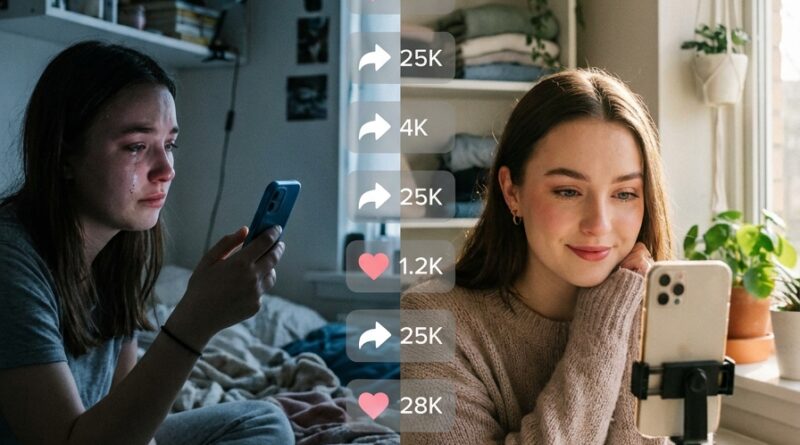
Inside TikTok’s ‘Trauma Dump Glow-Up’: How Oversharing Therapy Talk Just Became Clout Currency
Your feed is not imagining this. TikTok has gotten weirdly comfortable with pain as a format. One clip starts with someone crying in their car, the next is a fast-cut confession about childhood trauma, and by the end there is a skin care routine, a gym selfie, and a caption about being in their healed era. It can feel honest. It can also feel a little exploitative, like therapy language got turned into a content template overnight. That tension is exactly why the tiktok trauma dump trend hits so hard. It blurs the line between real storytelling, public coping, and straight-up performance for views. If you have felt pulled in, drained, or even tempted to package your own worst moments into a neat before-and-after reel, you are not overreacting. The app rewards intensity. It does not reward recovery, privacy, or context nearly as much.
⚡ In a Hurry? Key Takeaways
- The tiktok trauma dump trend turns deeply personal pain into highly shareable short-form content, often rewarding shock and vulnerability more than actual healing.
- If you want to share your story, add boundaries first. Decide what stays private, wait until the moment has passed, and post from reflection instead of fresh distress.
- Watching too much of this content can quietly wear you down. Mute keywords, reset your feed, and remember that public disclosure is not the same thing as support.
What the TikTok trauma dump trend actually is
At its simplest, this trend is people sharing deeply personal pain in a way that fits TikTok’s style. Fast edits. Strong hook in the first two seconds. Very personal confession. Then some kind of lesson, diagnosis, healing update, or glow-up.
Sometimes it is thoughtful and useful. People talk about grief, abuse, addiction, burnout, mental illness, or family trauma in ways that help others feel less alone.
But there is another version of it. The one that feels optimized. The story is cut for suspense. The pain becomes the hook. Therapy words get used like hashtags. The ending often says, “look at me now.”
That is where people start feeling uneasy. Not because pain should stay hidden, but because the platform has turned pain into a genre.
Why this kind of content spreads so fast
It grabs attention immediately
TikTok rewards intensity. A video that starts with “I never told anyone this” has a much better chance of stopping a scroll than one that starts with “Here is a healthy boundary tip.”
It creates instant emotional stakes
People are wired for stories. Especially stories about struggle and survival. We want to know what happened. We want resolution. We want the reveal.
It uses therapy language people already recognize
Words like trauma, triggers, narcissist, attachment style, dissociation, healing, and boundaries are now common online. That can be helpful when people finally have words for what they are feeling.
It can also flatten complex issues into easy labels. Suddenly every bad ex is a narcissist, every hard conversation is gaslighting, and every public breakdown gets framed as healing in real time.
The algorithm loves repeatable formats
Once one “day in the life of someone with…” video blows up, the app serves you ten more. Then twenty. Soon it starts to feel normal to narrate your most painful memories to millions of strangers.
Why it feels meaningful and a little off at the same time
This is the part a lot of people struggle to explain. Some of these videos are genuinely brave. They help reduce shame. They help viewers name things they never understood before. They can make someone feel seen at 1 a.m. when nobody else is around.
But the format itself can still be a problem.
TikTok is not a support group. It is not a therapist. It is not a close friend who knows your history and checks on you later. It is a machine built to keep attention moving. If your hardest moment gets views, the system learns to ask for more of that.
That is why the glow-up ending matters. It gives the video closure. It turns messy, long-term healing into a clean little arc. Suffering. Insight. Better lighting. New outfit. Stronger self.
Real healing usually looks a lot less cinematic.
What gets lost when trauma becomes content
Context disappears
A sixty-second clip cannot carry the full weight of abuse, mental illness, grief, or recovery. Details get shaved off. Nuance disappears. The audience fills in the blanks.
Viewers can start comparing pain
If your feed is full of dramatic disclosures, ordinary struggle can start to feel invalid. People may think, “Maybe mine does not count,” or, “Maybe I need to be more open to be taken seriously.”
Creators can feel pressured to keep performing vulnerability
If a creator’s biggest numbers come from their rawest content, there is a quiet incentive to keep opening the wound. Not always on purpose. But the feedback loop is there.
Comment sections become amateur therapy offices
Sometimes comments are kind and supportive. Sometimes they are invasive, skeptical, or wildly unqualified. Strangers diagnose. Push for more details. Demand updates. Argue over who had it worse.
Is oversharing always bad? No. But timing matters.
This is where we need a little balance. Sharing personal stories online is not automatically unhealthy. Some people build community that way. Some educate. Some process by writing or speaking publicly. Some simply do not want shame deciding what they can say.
The real issue is not “never share.” It is how, why, and when you share.
Posting from a place of reflection is very different from posting in the middle of a spiral. One is storytelling. The other can become self-exposure on demand.
How to tell if a post is helping you or using you
Ask yourself three quick questions
Why am I posting this?
Do you want connection, awareness, and honesty? Or are you hoping strangers will give you the care you need right now?
Would I be okay if this reached the wrong people?
That includes employers, family, exes, classmates, and people who dislike you.
Will this still feel true next month?
Strong emotions can push us to publish things we would rather have kept private once the storm passes.
A useful rule of thumb
If you are still actively falling apart, maybe do not make the algorithm your witness. Draft it. Save it. Send it to one trusted person instead.
How to watch this content without wrecking your own head
You do not have to quit TikTok to protect yourself. You just need better filters.
Mute keywords and phrases
If certain topics leave you spiraling, use TikTok’s content filters. Block words tied to specific triggers or repeated themes that are exhausting you.
Notice your body, not just your opinions
You might think, “I am just watching,” while your nervous system is getting hammered. If you feel heavy, jumpy, numb, or emotionally flooded after scrolling, that is useful information.
Reset the feed when needed
Skip, hold, and mark content as not interested. Search for lighter or more practical topics on purpose. The app learns from what you linger on, even if you hate-watch it.
Do not confuse resonance with diagnosis
A relatable video can help you feel less alone. It cannot tell you exactly what condition you have, what your ex had, or what your childhood “means” without a lot more context.
If you want to share your own healing journey, do it with guardrails
Share scars, not open wounds
You do not need to be perfectly healed to speak, but there is a big difference between honest reflection and live-streaming fresh pain.
Keep some details for yourself
You can tell the truth without telling everything. Names, exact events, family details, medical specifics, and ongoing crises do not all need to become public property.
Write the boundary before you post
Try a simple rule like this. “I will share what I learned, but not the part I am still trying to survive.” That one line can save you a lot of regret.
Turn off the pressure to perform recovery
You do not owe your audience a glow-up ending. Healing is allowed to be boring, slow, nonlinear, and private.
Why the “healed era” ending is so seductive
Because everyone likes closure. Viewers do. Creators do. Brands definitely do. A neat recovery arc is easier to watch than the truth, which is that most people circle the same issues many times before anything really sticks.
The glow-up frame says, “I suffered, but now I am stronger and hotter and wiser.” That story feels satisfying. It is also very easy for platforms to promote because it keeps vulnerability aspirational.
That does not make every healed-era video fake. It just means the format can oversell certainty. It can make recovery look like a reveal instead of a process.
What healthy sharing looks like online
Healthy sharing usually has a few signs.
- It leaves room for complexity.
- It does not demand emotional labor from strangers.
- It avoids turning a diagnosis into an identity costume.
- It respects the privacy of other people in the story.
- It sounds grounded, not baited for shock.
In other words, it informs more than it performs.
At a Glance: Comparison
| Feature/Aspect | Details | Verdict |
|---|---|---|
| Trauma-dump content | Highly personal, emotionally intense, often framed for maximum engagement and quick payoff. | Can build connection, but easy for the platform to exploit. |
| Intentional story-sharing | Reflective, bounded, focused on lessons or awareness without exposing every detail. | Best option for creators who want honesty without regret. |
| Viewer impact | Can create empathy and community, but may also trigger, drain, or normalize oversharing. | Worth curating carefully to protect your mental health. |
Conclusion
The tiktok trauma dump trend is not just another passing aesthetic. It is changing what people think is normal to share, and how quickly pain gets packaged into content with a neat little recovery bow on top. Some of that openness is genuinely useful. Some of it is the algorithm turning vulnerability into a product. The goal is not to shame anyone for telling the truth. It is to remember that your hardest moments do not have to be public to be real, valid, or worth caring about. If you watch this kind of content, set limits. If you make it, set boundaries first. That way you can still tell your story with intention, protect your own mental health, and avoid handing your worst moments over as free content to a system that only knows how to count views.