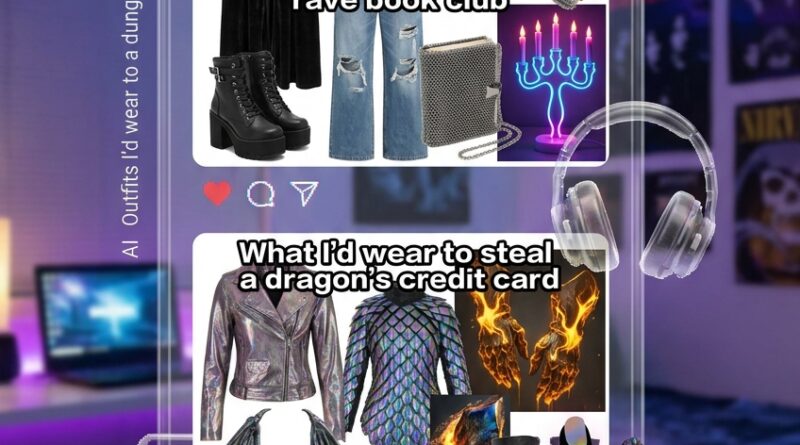
Inside TikTok’s Fantasy Fashion Boards: How ‘Outfits I’d Wear To…’ Became Gen Z’s New Mood Ring
Your feed did not accidentally turn into a digital dress-up game. If it feels like everyone suddenly has a board called “outfits I’d wear to inherit a haunted castle” or “looks for getting ghosted in Milan,” you are not imagining it. The TikTok fantasy fashion outfits trend really did hit fast, and part of what makes it confusing is that it looks silly, stylish, ironic, and serious at the same time. That is exactly why it is spreading. These posts are not just about clothes. They are tiny identity experiments dressed up as mood boards. They let people try on a version of themselves without buying the whole lifestyle, and they give viewers an easy format to copy, remix, and comment on. So yes, it is a real trend. But more than that, it is a clue. It shows how Gen Z is turning personal style into public storytelling, with the algorithm acting like both audience and casting director.
⚡ In a Hurry? Key Takeaways
- The TikTok fantasy fashion outfits trend is real, and it works because it mixes style, roleplay, and easy-to-copy posting formats.
- If you want to join in, make your boards more specific and personal instead of copying the same polished AI-looking images everyone else is using.
- Watch these posts as a culture signal. They often preview which aesthetics, colors, and vibes are about to move from screens into real outfits.
Why these “outfits I’d wear to…” posts blew up so fast
The format is simple, which is usually the first sign a trend has legs. Pick a hyper-specific scenario. Build a set of looks around it. Make it dramatic, funny, romantic, unhinged, or all four. Then let the comments add to the story.
That simplicity matters. TikTok loves formats people can understand in one second and remake in five minutes. “Outfits I’d wear to…” is basically a mad-lib for style. It invites endless copies because the prompt changes, but the structure stays the same.
It also hits a sweet spot between aspiration and safety. You can post “outfits I’d wear as the villain’s favorite niece at a winter gala” without having to actually attend anything, buy anything, or explain your whole identity. It is fashion without the full commitment.
What makes it different from normal outfit inspiration
Classic outfit content usually asks, “Would I wear this in real life?” Fantasy boards ask something more interesting. “Who would I be if my life had better lighting, a weirder plot, and a stronger coat collection?”
That shift is the whole story.
Older fashion posting often centered on shopping, trends, and taste. This new wave centers on narrative. The clothes are props, but the real product is the character. One board might say “outfits I’d wear while exposing a family secret on the Amalfi Coast.” Another might lean into “looks for surviving a breakup in a city where everyone has perfect bangs.” The point is not realism. The point is emotional world-building.
It is collaborative fiction, not just consumption
People are not only posting boards. They are replying to them, duetting them, adding better scenarios, ranking the looks, and arguing about whether the third slide is “too rich for a train station betrayal.” That turns fashion into a shared story game.
And that is very Gen Z. Online identity is less fixed than it used to be. It is iterative. You test a version of yourself in public, see what lands, then refine it.
Why the algorithm loves fantasy fashion
TikTok rewards content that is instantly legible and emotionally sticky. These boards do both.
First, they stop the scroll because the premise is odd. “Outfits I’d wear to fake my death and reappear at fashion week” is simply harder to ignore than “fall outfit ideas.”
Second, they invite comments. People love correcting, improving, and extending a fantasy. They want to say which slide fits the character, which shoe ruins the plot, and which bag says “trust fund with secrets.”
Third, they are easy to save. Even if nobody is truly dressing for a moonlit divorce in Paris, viewers still save the color palette, coat shape, makeup idea, or general vibe.
That is why the TikTok fantasy fashion outfits trend can look absurd and practical at once. It is entertainment on the surface, trend forecasting underneath.
What it says about where culture is heading
This is the part that matters beyond TikTok.
Fantasy boards show that style online is moving away from strict trend tribes and toward more fluid, story-based identity. Instead of saying, “I am clean girl” or “I am indie sleaze,” people are mixing references depending on mood, setting, and imagined plotline.
That means aesthetics are becoming more temporary and more situational. You are not choosing one permanent look. You are choosing a cast of selves.
People are testing identity in public
These posts act like low-risk rehearsal spaces. Someone can flirt with old-money styling, chaotic boho layering, gothic romance, office siren tailoring, or futuristic sportswear, all without announcing a total reinvention. If the post lands, great. If not, it was just a joke board.
That flexibility makes the format powerful. It lowers the cost of experimentation.
Style is becoming less about buying and more about framing
One reason these boards work is that context now matters as much as the garment. A plain black dress means one thing on a shopping site. It means something else when it is labeled “what I’d wear to accept an apology I do not plan to accept.”
That framing gives ordinary pieces new life. It also explains why trend cycles now move so quickly. The same outfit can be endlessly repackaged through different stories.
Why some of these boards feel weirdly the same
If you have noticed that many fantasy fashion posts blur together, you are not being cynical. A lot of them do share the same glossy look. Similar poses, similar color grading, similar “luxury but haunted” styling, similar faces that do not quite look real.
That is where people start using image tools, recycled Pinterest pools, and hyper-polished references that flatten the fun out of the format. The result is a board that looks expensive but says nothing.
The risk is obvious. A trend built around imagination can quickly become generic if everyone reaches for the same visual shortcuts.
How to join the trend without making bland AI sludge
You do not need a design degree, expensive wardrobe, or cinematic life to do this well. You just need sharper choices.
Start with a specific scenario
“Outfits for brunch” is dead on arrival. “Outfits I’d wear to meet my ex’s nicer new girlfriend at a bookstore” has tension. The more oddly precise the setup, the more personality the board gets.
Use references from your real taste
Pull from old movie stills, thrift finds, screenshots, family photos, street style, album covers, or your own closet. The point is to build a world that feels like you, not like a machine averaged ten Pinterest boards together.
Let one detail do the storytelling
A scuffed boot, a too-large ring, a rain-stained trench, or a lipstick shade can carry more character than a full luxury head-to-toe look. Tiny clues make a board feel lived in.
Mix polished and imperfect images
If every image is crisp, symmetrical, and expensive-looking, the board starts to feel lifeless. One grainy photo, one candid street shot, or one messy mirror selfie can make the whole set feel more human.
Write captions like a person, not a brand
The best versions of this trend sound like someone letting you into their brain for ten seconds. Dry humor helps. Specificity helps more.
How to read these boards like a trend spotter
If you want to know which aesthetics might leave the screen and hit real life, watch the repeated details, not just the dramatic themes.
Pay attention to:
Color patterns
If multiple fantasy boards keep circling oxblood, icy gray, butter yellow, faded navy, or dark olive, those shades may be warming up for wider use.
Silhouettes
Ignore the far-fetched scenario and look at shapes. Are people favoring long coats, soft tailoring, tiny cardigans, dramatic boots, sheer layers, oversized leather, or structured bags?
Mood shifts
These boards often reveal emotional trends before retail catches up. If the feed turns from ultra-clean and minimalist toward messy romantic, melancholic, eccentric, or “main character in light danger,” that usually points to a broader taste change.
Is this just another microtrend?
Yes and no.
The exact phrasing and format may cool off, because TikTok always burns through templates fast. But the bigger shift is likely to stay. People increasingly want style content that feels participatory, emotional, and narratively rich. They want clothes to signal a mood, a plot, a joke, a version of self.
So the trend line to watch is not only “fantasy boards.” It is the move toward fashion as social storytelling.
What brands and creators are learning from it
Smart creators already understand that viewers do not only want product links. They want a reason to care. A sweater sells better when it belongs to a character. A pair of shoes gets saved more when it fits a scenario.
Brands will absolutely try to copy this. Some will do it well. Many will overdo it and turn something playful into ad copy. That usually kills the magic.
The creators who keep winning will be the ones who make viewers feel like co-authors, not customers.
At a Glance: Comparison
| Feature/Aspect | Details | Verdict |
|---|---|---|
| Why it is trending | Easy format, funny prompts, high comment potential, and strong save value | More than algorithm noise. It has real momentum. |
| Cultural meaning | Turns fashion into identity testing and collaborative storytelling | A useful clue for where online self-presentation is heading |
| How to participate well | Use hyper-specific scenarios, real references, and imperfect personal details | Best way to stand out and avoid the bland AI look |
Conclusion
The TikTok fantasy fashion outfits trend matters because it shows, in real time, how style is changing from simple outfit inspiration into something closer to shared fiction. That is why it feels bigger than a cute meme. People are using these boards to test identities, signal moods, build mini worlds, and quietly vote on which aesthetics should cross over into real life next. If you understand that now, you can read your feed more clearly. You can spot which looks are about to escape the screen, see how friends and creators are trying on new versions of themselves, and join in without defaulting to the same glossy, empty AI style. Think of it less like a passing fashion gimmick and more like a weather report. It tells you where taste, self-presentation, and algorithm games are headed, before the rest of the culture writes it down.