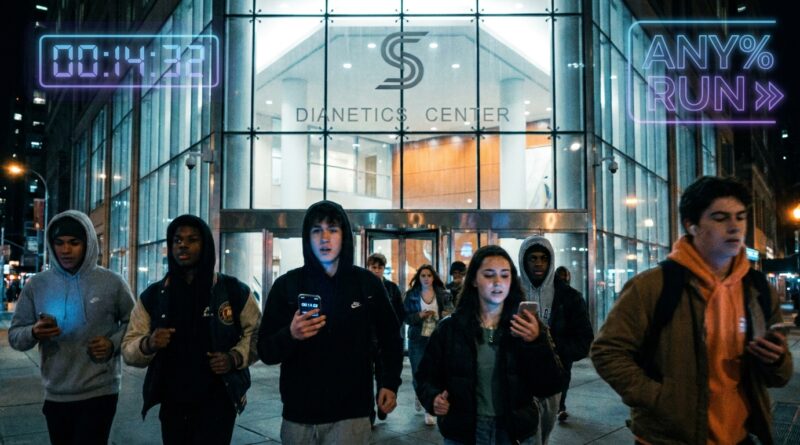
Inside TikTok’s ‘Scientology Speedrun’ Wave: How Gamifying Gate‑Crash Culture Quietly Became Gen Z’s Riskiest New Clout Hack
If your TikTok feed suddenly feels like a live-action video game, you are not imagining it. The TikTok Scientology speedrun trend took a very old institution and turned it into a series of challenge levels. Walk in. Film everything. Ask pointed questions. Try to get kicked out. Post the clip. Repeat. At first glance, it can look like prank content with a political edge. Then someone gets detained, security steps in, police show up, and the joke stops landing. That uneasy feeling matters. What you are really seeing is a new kind of internet behavior where gaming logic, social performance, and real-world risk get mixed together in public. The point is not just what happens inside a Scientology building. The bigger story is how TikTok trains people to package confrontation as content, and how fast a niche bit can turn into a copycat format with real consequences.
⚡ In a Hurry? Key Takeaways
- The TikTok Scientology speedrun trend is less about one group and more about teens turning real places into game maps for views.
- If you track online culture, watch for gaming language like “speedrun,” “quest,” and “NPC” showing up in real-world challenge videos. That is often your early warning sign.
- This is risky because the format rewards escalation, copycats, and public conflict, which can quickly spill into trespassing issues, safety problems, and brand headaches.
What the TikTok Scientology speedrun trend actually is
At its simplest, the trend takes a gaming term and drops it into the real world.
A speedrun in gaming means finishing a game or challenge as fast as possible, often by finding shortcuts, loopholes, and predictable system behavior. On TikTok, creators started using that same frame for entering Scientology locations, testing how long they could stay, how far they could get, and what reaction they could trigger before being removed.
That framing matters.
It changes the story from “I am visiting a controversial institution” to “I am beating a level.” Once that happens, people watching no longer see a building, staff, rules, or possible danger first. They see mechanics. Guards become obstacles. Front desks become checkpoints. Reaction clips become proof of progress.
That is why the trend feels so weirdly familiar even if you have never watched one of these videos before. It borrows the emotional language of gaming. The audience instantly understands the format.
Why this caught on so fast
TikTok loves content with clear rules
The platform is built for formats people can copy in minutes. A dance has steps. A prank has a setup. A “speedrun” has goals, timing, and a visible end point. It is incredibly easy to imitate.
That makes the TikTok Scientology speedrun trend almost perfect for the app. It is structured enough to repeat, but messy enough to feel spontaneous.
It lets people wear three masks at once
This is a big reason the trend spread.
A creator can present themselves as a prankster, an activist, and a comedian all at the same time. If viewers approve, it is brave exposé content. If viewers push back, it was “just a joke.” That flexibility protects the creator socially. It also makes the trend harder to critique, because everyone involved can claim a different motive.
Conflict is the product
These videos are not really about information. They are about tension.
The whole structure points toward escalation. Viewers wait for the moment staff react. They wait for confrontation. They wait for the “boss fight.” That means the content format quietly rewards pushing harder each time.
Why Scientology became the target
Scientology is not random here. It already carries heavy internet mythology. For years, it has been discussed online as secretive, powerful, litigious, and hard to access. In algorithm terms, that is perfect fuel.
It gives creators three things at once.
- A controversial target that feels culturally legible.
- A built-in audience that expects drama.
- A setting where even a small reaction can look meaningful on camera.
That does not mean every person participating had the same motives. Some likely saw it as anti-institution protest. Some saw it as pure clout chasing. Some probably just copied a format because it was trending. But the target itself made the videos easier to explain, easier to caption, and easier to spread.
The bigger shift hiding underneath
This is the part people miss when they talk about the trend like it is just another prank.
What is changing is not only the target. It is the mental model.
Younger creators increasingly understand public life through systems language borrowed from games and the internet. They talk about “glitches,” “side quests,” “main character moments,” “NPC behavior,” and “speedruns.” Most of the time, that language is funny and harmless. But sometimes it starts to reshape behavior.
When that happens, real institutions stop feeling fully real. They start feeling like maps to test.
That has consequences:
- Rules begin to look like game mechanics instead of boundaries.
- Authority figures become content props.
- Risk feels abstract until it is suddenly not.
- Audience applause pushes people to go one step further.
This is why the TikTok Scientology speedrun trend matters beyond its niche. It is a clean example of “IRL game logic,” where online culture teaches people to turn physical spaces into stages for repeatable challenge content.
Why it stopped being funny once cops showed up
Because reality always breaks the format eventually.
TikTok clips compress time. They flatten context. They make conflict look manageable right up until the point it is not. A funny caption can sit on top of a situation involving trespassing accusations, physical removal, harassment complaints, or police contact. The video still looks like content. The person inside it is now dealing with the real-world bill.
That gap is where these trends get dangerous.
People copy the polished version, not the aftermath. They see the comments, the likes, and the easy story structure. They do not see the legal stress, the travel risks, the possibility of misreading a tense situation, or how fast a crowd can make things worse.
How TikTok legitimizes trends like this
Repetition makes weird behavior feel normal
If you see one clip, it looks unusual. If you see twenty, it starts to feel like an established category. That is one of TikTok’s strongest effects. It does not just show behavior. It normalizes it through repetition.
The comments write the script
Watch any trend like this and the audience starts building levels for the next person.
“Try this location.”
“Ask this question.”
“See if you can last longer.”
Now the crowd is not just watching. It is co-designing the challenge.
Irony provides cover
One reason adults often struggle to read trends like this is that the tone keeps shifting. A creator can be sincere in one sentence, mocking in the next, and performatively detached after that. That ironic layer helps content travel because it lowers the social cost of participation. You can always pretend you were less serious than you looked.
What brands, creators, and trend-watchers should learn from it
You do not need to care about Scientology specifically to learn from this.
The useful lesson is pattern recognition. When you spot a trend that turns a real-world setting into a challenge map, take it seriously early. The labels might change. Next time it may not involve a church, movement, or controversial institution. It could be retail workers, hotel lobbies, museums, office buildings, schools, or live events.
Watch for these signs:
- Gaming language gets attached to real places.
- The challenge has clear, repeatable steps.
- Success is measured by reaction, not information.
- The audience proposes escalation in comments.
- Creators hide behind “it was satire” after pushback.
If you are a brand or platform watcher, this is your cue to stop treating it as random youth chaos. It is a format. Formats spread.
If you are a parent, teacher, or older viewer, here is the plain-English read
The kids doing this are not necessarily more reckless than previous generations. But they are operating inside a media system that rewards packaging real life like gameplay.
That changes what seems normal.
It can make high-friction public behavior feel creative, smart, or socially valuable long before anyone asks whether it is safe, fair, or useful. If you are trying to talk to a teenager about it, skip the “this is dumb” lecture. That usually goes nowhere.
Instead ask:
- What is the actual goal here?
- Who is the audience rewarding?
- What happens if ten people copy this?
- What part of this would still make sense without a camera?
Those questions get at the real issue. They move the conversation from morality panic to media literacy.
At a Glance: Comparison
| Feature/Aspect | Details | Verdict |
|---|---|---|
| What it looks like | A prank, protest, or edgy field trip filmed for TikTok. | Misleadingly simple on the surface. |
| What it really is | Gaming mechanics applied to real institutions, with clout and audience reaction as the reward loop. | A bigger cultural pattern worth watching. |
| Main risk | Escalation, copycats, police involvement, and blurred lines between activism, trolling, and harassment. | Not harmless once it leaves the screen. |
Conclusion
The TikTok Scientology speedrun trend is useful to study because it shows the next phase of internet culture in plain view. Teens are not just making jokes online. They are importing the rules of games into public life, then filming the results as entertainment, protest, or both. If you can see that pattern here, you will spot it faster the next time a “funny” format starts turning stores, campuses, events, or institutions into challenge maps. That helps the community today because this trend is the clearest live example of a cultural shift that can quickly spill from your For You Page into police reports, PR crises, and copycat chaos. The smart move is not panic. It is paying attention early, naming the pattern clearly, and treating “IRL game” trends like the serious media signals they are.