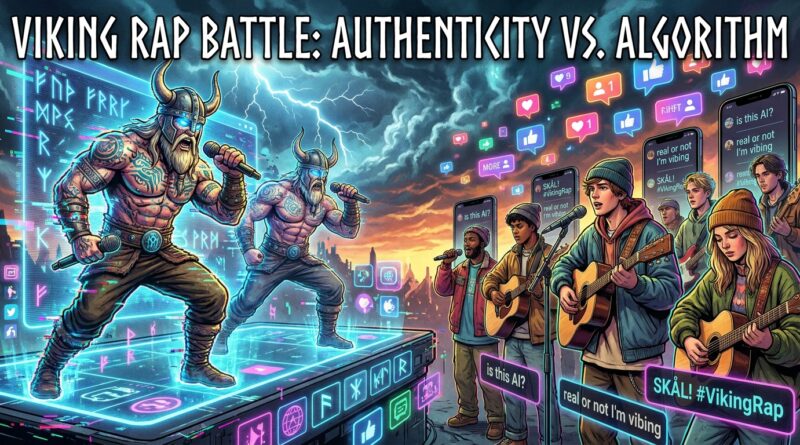
Inside TikTok’s Viking Rap AI Wave: How Norse ‘Music Slop’ Quietly Became Gen Z’s New Debate Over What Counts As Real Art
You are not imagining it. One minute TikTok is showing you skincare, lunch hacks, or football clips. The next, a giant bearded “Viking” with face tattoos is rapping about Odin, mead, and Valhalla over a beat that sounds weirdly polished and oddly empty at the same time. It is funny for about ten seconds. Then the confusion sets in. Are people sincerely listening to this stuff, or are they boosting it as a joke and accidentally turning it into a real genre? That frustration matters, because the Viking rap AI TikTok trend is not just another dumb meme. It is a test case for how AI music spreads, how irony turns into fandom, and how younger listeners are sorting out what feels human in a feed full of synthetic content. If even fake Norse battle rap can rack up millions of views, the bigger question is not “why is this popular?” It is “how do we judge art when the algorithm keeps blurring the source?”
⚡ In a Hurry? Key Takeaways
- The Viking rap AI TikTok trend blew up because it mixes novelty, easy shareability, and irony, not because everyone suddenly wants Norse hip-hop.
- If you want to tell whether a creator is worth following, look past the hook and check for signs of real authorship, repeat style, and honest labeling.
- The bigger issue is not just “AI slop.” It is that repeated joke-sharing can train the algorithm to treat synthetic music as culture, whether listeners mean to or not.
Why this odd little genre got so big
On paper, AI Viking rap sounds too ridiculous to matter. In practice, it is exactly the kind of thing TikTok loves.
It has instant visual shorthand. Fur cloaks. Braids. Glowing eyes. Snowy battle scenes. It has a recognizable joke. Tough Norse warrior, but make it trap. And it has a chorus built for short clips. Even if the song itself is thin, one catchy line about Valhalla can do numbers in a 12-second edit.
That is the key. TikTok does not reward depth first. It rewards repeatability. The Viking rap AI TikTok trend works because viewers understand it right away, and creators can remix it endlessly.
One person posts a fake Viking anthem. Another duets it. Another uses it over gym footage. Another uses it ironically over someone failing to assemble IKEA furniture. Before long, the song is not just a song. It is a format.
The “is this a joke or not?” problem
This is where people get stuck. A lot of viral AI music lives in a weird middle zone between parody and real fandom.
Some listeners are clearly in on the joke. They know the track is shallow, synthetic, and stitched together from genre clichés. They share it because it is absurd.
Others genuinely like the sound. Maybe not enough to buy an album, but enough to add it to workout playlists or use it in edits. That matters too.
Once enough people use something ironically, the algorithm stops caring about the original intent. It just sees engagement. The joke becomes a recommendation. The recommendation becomes a scene.
That is how “slop” starts looking like culture.
What people mean when they say “AI slop”
The term is harsh, but it points to something real.
When people call Viking rap AI “slop,” they usually mean content that is fast, formulaic, emotionally flat, and made to flood feeds rather than say anything specific. The vocals may sound dramatic. The beat may hit hard enough. But the whole thing often feels assembled from familiar parts instead of lived experience.
Think about the common ingredients. Stock epic chanting. Generic battle imagery. Lyrics that mention gods, war, destiny, and drinking from skulls. A voice that sounds almost human, but not attached to an actual performer you can picture writing, revising, or performing the track.
None of that automatically makes it worthless. Pop music has always used formulas. But AI makes it much easier to mass-produce those formulas at scale. That scale is what changes the feeling.
Why Gen Z and Gen Alpha care more than older critics think
It is easy to dismiss this as kids falling for nonsense online. That misses the point.
Younger users are not just passively absorbing AI music. They are actively negotiating it. They are deciding what counts as authentic enough. They are building taste in public, in front of recommendation systems that keep nudging them toward the fastest, funniest, most frictionless content.
For them, the question is not “Is this made by AI?” Full stop. It is more personal.
Does this feel like someone means it?
Is this creator actually building something?
Am I enjoying the song, or just the bit?
If I keep posting this, what am I helping grow?
Those are smart questions. They are also the same questions the rest of us are about to face in every corner of media.
How irony accidentally turns into promotion
Here is the part that makes people uneasy. Even if you hate the Viking rap AI TikTok trend, your reaction can still feed it.
Commenting boosts reach
Mocking a clip in the comments still tells the platform the clip is worth showing to more people.
Duets and stitches turn criticism into distribution
If you react to a synthetic song by reposting it to explain why it is bad, you still help it travel.
Hate-listening looks a lot like real listening
Algorithms are not great at reading your soul. Replay is replay. Watch time is watch time.
That is why these tracks can spread so fast. They do not need universal approval. They just need enough curiosity, annoyance, and amusement to keep the loop going.
How to tell whether a creator behind the trend is worth your attention
You do not need a musicology degree for this. You just need a quick filter.
1. Check whether they label the AI use clearly
Honest creators usually tell you what tools they used, what they wrote themselves, and what part is synthetic. That does not make the music good by itself, but it is a sign of respect.
2. Look for a consistent point of view
Do all the songs sound like random prompts, or do they reflect an actual sense of humor, style, or story? A real artist can use AI and still make choices that feel theirs.
3. See whether there is any world beyond the clip
Can they perform live? Talk about their influences? Share drafts? Explain why they made the track? Or is every post just another interchangeable “epic Viking trap anthem”?
4. Watch for repetition without growth
If every upload feels like the same mead hall beat with slightly different god names, that is usually a sign the account is farming attention, not building a body of work.
5. Trust your boredom
This one sounds simple, but it helps. If the first clip made you laugh and the tenth felt empty, that is useful information. A lot of AI music burns bright as novelty and fades fast when the surprise wears off.
What this trend says about “real art”
The argument gets messy because people often force it into two extremes.
Extreme one says AI music is fake by definition, so none of it matters.
Extreme two says tools are just tools, so if people enjoy it, the debate is over.
Reality is more annoying than that. A tool can be valid and still flood the zone with low-effort work. Listeners can sincerely enjoy something and still feel uneasy about how it was made. A creator can use AI in a thoughtful way, while dozens of copycats use the same systems to churn out disposable clones.
So the real question is not “AI or human?” like it is a courtroom drama. It is “What kind of effort, intention, and connection can I actually feel here?”
That is still an art question. It always has been.
Why the Viking part matters
You could swap Vikings for cowboys, anime heartbreak, medieval monks, or cyberpunk girlfriends, and the mechanism would be similar. But the Norse theme adds a few things that make it especially viral.
First, it is instantly memeable. Everyone recognizes the broad fantasy look, even if the history is nonsense.
Second, it carries borrowed seriousness. If you add horns, drums, and mythic language, even a flimsy song can feel “epic” for a moment.
Third, it sits right on the edge of cringe and cool. That edge is social media gold.
People love content they can enjoy, mock, and reuse all at once.
A practical framework for the next wave of synthetic micro-genres
This is the part worth keeping. The Viking rap AI TikTok trend is not important because of Vikings. It is important because it shows the pattern you are going to see again and again.
Ask these four questions
What is the hook?
Is it the music itself, or just the costume and concept?
What is the labor?
Did someone shape this in a meaningful way, or mostly generate and upload?
What is the community doing?
Are people discussing it, remixing it thoughtfully, and forming taste around it? Or just using it as disposable background noise?
What happens if this scales?
Would more of this enrich the culture, or just clog discovery for human creators trying to break through?
If you use those four questions, you can get past the lazy “everything is fake now” complaint and make better calls about what deserves your time.
Should you stop engaging with it entirely?
Not necessarily.
You do not have to become the fun police. Sometimes a silly AI Viking track is just a silly AI Viking track. It is okay to laugh.
But if you are worried about accidentally helping junk drown out better work, be a little more intentional.
Try this instead
Save and share human-made artists when you find them. Comment on creators who are transparent and interesting. If you want to critique a trend, talk about it without embedding the exact clip everywhere. And if an account feels like pure volume farming, do the hardest thing on the internet. Scroll past.
That sounds small. It is not. Recommendation systems are built from millions of tiny decisions like that.
At a Glance: Comparison
| Feature/Aspect | Details | Verdict |
|---|---|---|
| Why it spreads | Strong visual gimmick, catchy short-form hook, easy irony and remix potential | Built for TikTok, even if the music itself is thin |
| How to judge it | Look for transparency, creative intention, consistency, and something beyond one joke | Some creators may be worth watching, many are just chasing reach |
| What it means for music culture | Shows how fast AI micro-genres can blur parody, fandom, and algorithmic spam | A useful test case for the bigger “what feels real?” debate |
Conclusion
The Viking rap AI TikTok trend looks goofy on the surface, but it is doing serious cultural work underneath. It sits right where algorithmic spam, fandom ethics, and shifting ideas of authenticity all crash into each other. That is why it keeps sparking arguments out of proportion to the music itself. If you can learn to read this one weird corner of the feed, you get a much better grip on what is coming next. Faux folk ballads. Synthetic boybands. AI sad-girl anthems. The exact costume will change, but the pattern will not. And that is the useful part. Once you know how to spot the hook, the labor, the community, and the scale problem, you do not have to just throw up your hands and say everything sounds fake now. You can make smarter choices about what to ignore, what to enjoy, and what is actually worth caring about.