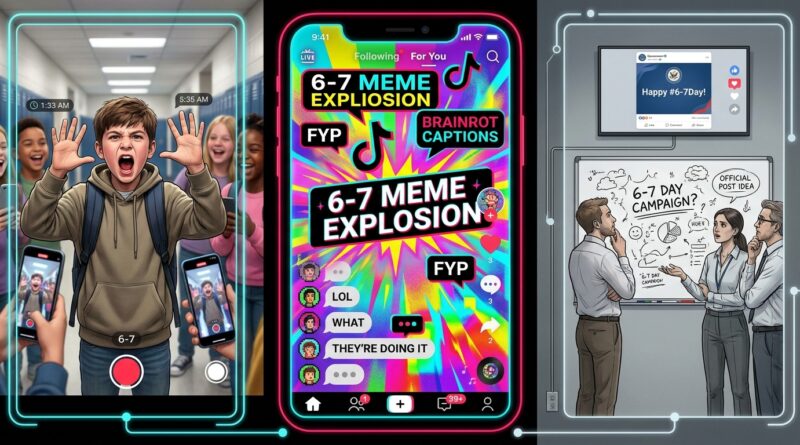
Inside TikTok’s ‘6‑7 Day’ Takeover: How Gen Alpha Turned Two Numbers Into A Global Culture War Flashpoint
If your social feeds suddenly look like a stadium full of people shouting “6-7” at each other, you are not behind. You are just watching a very online joke hit its messy middle stage. That is the moment when a niche Gen Alpha bit stops being funny only to insiders and turns into a public guessing game for everyone else. TikTok started it, Instagram Reels helped spread it, and then the real signal flare went up when brands, celebrities and even government social accounts tried to join in. That usually means one thing. The joke has escaped the group chat.
So here is the simple version of the 6-7 TikTok trend explained. It is less a deep message and more a viral call-and-response. The numbers became a kind of cultural password. People use them to signal they are in on the joke, test whether others are, or mock how fast the internet can inflate nonsense into a full event. Today being 6/7 on the US calendar poured gasoline on that trend, turning an odd little meme into the loudest thing on a lot of feeds.
⚡ In a Hurry? Key Takeaways
- “6-7” is a Gen Alpha style meme that works mostly as an in-joke and social signal, not a serious coded message.
- If you manage a brand or creator account, do not force it late. Explain it, react to it, or skip it. Posting “6-7” with no context usually reads try-hard.
- The real value here is learning the meme life cycle. Once officials, celebrities and news pages pile on, the joke is often peaking or already cooling off.
What does “6-7” actually mean?
The frustrating answer is that it does not have one clean, stable meaning. That is part of why it spread.
For a lot of users, “6-7” works like a password. You post it, comment it, or yell it in a video, and other people respond because they know they are supposed to. It is internet participation for participation’s sake. Think of it like shouting the chorus of a song without needing to know who wrote it.
That is why so many older users feel like they missed a meeting. They did not. The joke is intentionally thin. Its power comes from repetition, not depth.
Why two numbers?
Because numbers are easy to copy, easy to caption, and weird enough to make people ask questions. Curiosity is fuel on TikTok. If someone sees “6-7” over and over, they stop scrolling and start searching. That search behavior helps the trend grow.
In other words, confusion is not a bug here. It is the engine.
Why did it explode today?
Today is 6/7 in the US date format, and that gave the meme a perfect hook. A joke that had been simmering suddenly had a built-in holiday. Once that happens, every kind of account jumps in.
Creators post skits. Reels pages repost clips. Celebrities half-understand it and share anyway. Political teams and city agencies try to sound young for a day. Newsrooms publish explainers because search traffic spikes. Then your boss sees one of those explainers and asks if the interns know what it means.
That is how a niche joke becomes a culture-war flashpoint. Not because the numbers are serious by themselves, but because every layer of the internet starts arguing over whether it is funny, stupid, harmless, overhyped, or a sign of societal collapse.
The real story is not the joke. It is the takeover pattern.
If you want the 6-7 TikTok trend explained in a useful way, look less at the phrase and more at the pattern.
Phase 1: Kids make a weird joke
Usually this starts in small circles. Maybe a sound, a comment format, a number sequence, or a nonsense phrase. The point is that it feels native to the group.
Phase 2: The algorithm notices
High repetition, quick comments, and curiosity searches push it outward. People do not need to understand it to engage with it.
Phase 3: Outsiders arrive
This is when explainers start. “What does this mean?” becomes a content category of its own. A meme can now feed on both fans and confused spectators.
Phase 4: Institutions pile on
Brands, officials, campaigns, school accounts, local police departments, sports teams. This is usually where the joke gets stretched thin. Some posts land. Most feel like your uncle trying to use teen slang at Thanksgiving.
Phase 5: Backlash and burnout
The original crowd starts mocking the late arrivals. The meme becomes less about the joke and more about who ruined it, who misunderstood it, and who is still pretending it is fresh.
Why Gen Alpha humor feels impossible to decode
Because a lot of it is built to resist neat explanation.
Millennial and Gen Z internet humor often had references you could trace. A movie quote. A fandom. A viral Vine. Gen Alpha humor is often more abstract. It likes randomness, repetition, anti-jokes, and a kind of performative meaninglessness. That does not make it empty. It just means the social function matters more than the literal text.
“6-7” fits that pattern perfectly. It is useful because it makes people react. The reaction is the content.
Why official accounts keep getting this wrong
Because they treat a living joke like a coupon code.
When a meme is still forming, it has a tone. If an account barges in with “Happy 6-7 Day, fellow youths,” people can smell the boardroom from across the app. It feels processed.
The safer move is usually one of three things:
- Acknowledge the trend without pretending to own it.
- Explain it for your audience if education fits your brand.
- Ignore it if you are already late.
That last option is underrated. Not every viral moment needs your logo on it.
What creators and social managers should do with this
This is where the trend becomes useful, even if you never post “6-7” yourself.
1. Watch the comments, not just the videos
Comment sections show whether people are still enjoying the joke or already making fun of the accounts using it. If the comments are mostly “bro is late,” the window has closed.
2. Use explainers when search spikes
When people are confused, short decoder content can do well. “Here’s what 6-7 means and why your feed is full of it” is often more valuable than a clumsy participation post.
3. Do not confuse visibility with relevance
Just because everyone is posting about a trend does not mean your audience wants you to. Chasing every meme can make an account feel generic fast.
4. Learn the timing
The best moment is often early explanation or fast, clever reaction. The worst moment is after major institutions have already arrived.
Is there any deeper danger here?
Mostly, no. This looks more like a hype spiral than a harmful challenge or coded threat. But there is still a useful caution.
When a meme is vague, people project onto it. Some assume it is secret slang with hidden meaning. Others overstate its importance because it is everywhere for a day. That is why context matters. Viral does not always mean meaningful. Loud does not always mean lasting.
For parents, teachers and workplace managers, the practical answer is simple. Ask what it is, do not panic, and avoid turning a goofy meme into a morality play. That usually gives it more power than it deserves.
So, is “6-7” already over?
Not instantly. But once celebrity reposts, corporate jokes and official accounts all flood in at once, you are usually at or near the top of the curve.
That does not mean people stop using it today. It means the meaning shifts. Early on, posting it says, “I am in on this.” Later, posting it says, “I saw this trending.” Those are not the same thing.
That shift is the whole lesson.
At a Glance: Comparison
| Feature/Aspect | Details | Verdict |
|---|---|---|
| What “6-7” means | A loose Gen Alpha in-joke, social signal, and call-and-response meme more than a fixed definition | More vibe than message |
| Why it blew up on 6/7 | The date gave the meme a perfect real-world hook, pushing creators, brands and media to amplify it at once | Classic viral acceleration point |
| Best response for brands and creators | React smartly, explain clearly, or sit it out if you are late | Context beats copycat posting |
Conclusion
Today being 6/7 turned a long-brewing Gen Alpha joke into a full public event. That is why your feeds feel so oddly synchronized right now. The useful part is not just knowing the 6-7 TikTok trend explained in plain English. It is seeing how fast a throwaway meme changes once celebrities, media outlets and official accounts jump in. If you make content, run social, or just like understanding why the internet feels weird on certain days, this is your decoder ring. Watch the pattern closely. The next “6-7” is probably already forming, and spotting when a joke goes from signal to stale is half the battle.