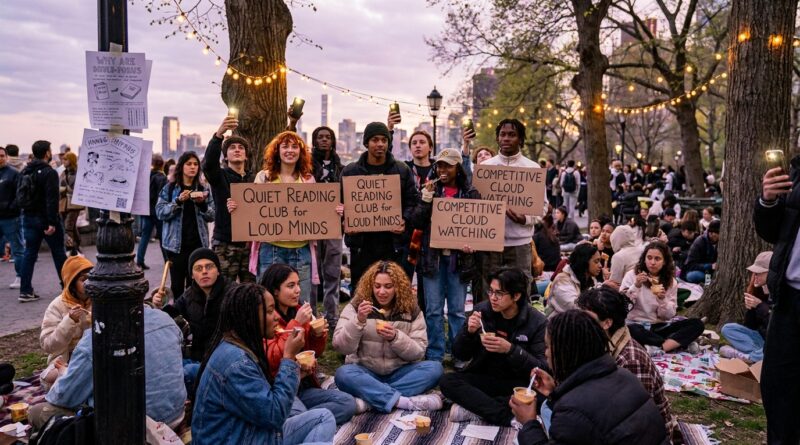
Inside TikTok’s ‘Eventslop’ Era: How Hyper‑Niche Meetups Quietly Became Gen Z’s New Way To Hack Real‑World Community
You are not imagining it. One week your feed is normal, and the next it is packed with videos of strangers meeting in a park to eat pudding with forks, rank each other’s auras, dress like office printers, or attend a meetup for people who all share one bizarrely specific trait. It looks silly at first. Then 300 people show up, everyone seems weirdly happy, and you start wondering why your own carefully planned event got 12 likes and three maybes. That frustration is real. These gatherings are not random internet nonsense. They are a new kind of low-pressure social format, and TikTok is acting like the spark, flyer, group chat, and hype machine all at once. The TikTok eventslop meetup trend is less about jokes than it is about belonging. Gen Z is using absurdity as a permission slip to meet offline without the heavy pressure of networking, dating, or joining some serious club with rules.
⚡ In a Hurry? Key Takeaways
- TikTok eventslop meetups work because they mix a joke, a simple ritual, and a low-stakes reason to show up in person.
- If you want to start one, keep the idea easy to explain in one sentence and easy to join without spending much money or effort.
- The best versions feel welcoming and lightly organized. Safety, clear location details, and basic crowd planning matter more than perfect branding.
What “eventslop” actually is
“Eventslop” sounds insulting, but it points to something very specific. These are events that feel fast, a little messy, highly memed, and almost too specific to be real. They often start as a joke post or a “what if we all just…” idea. Then people copy the format, remix it, and bring it into real life.
The “slop” part is the roughness. The flyer may look thrown together. The premise may sound dumb on purpose. The point is not polish. The point is instant social readability. You get it in two seconds, which means you can decide in two seconds whether it sounds fun.
That matters more than most brands realize. A polished event page can feel like homework. A goofy meetup with one rule feels like freedom.
Why these odd meetups blow up overnight
1. They remove the hardest part of socializing
Meeting strangers is awkward. A hyper-niche prompt gives everyone a script before they even arrive. If the meetup is “eat pudding with a fork in the park,” nobody needs a clever opener. The opener is already built in. You are all here doing the same ridiculous thing.
2. The joke makes the risk feel smaller
Gen Z has grown up online, where trying too hard can feel embarrassing. A semi-ironic event lowers the emotional stakes. If it is amazing, great. If it is awkward, well, the whole thing was already a bit of a joke. That makes it much easier to say yes.
3. They are made for the camera without feeling fake
These meetups produce good TikToks almost automatically. Short visual premise. Crowd payoff. Easy reactions. “I showed up to a fork pudding meetup and 500 people were there” is content. The event spreads because attending it also helps people participate in the story.
4. Specificity is the hook
Broad events are easy to ignore. “Come hang out with cool people” means nothing. “Hot girls with asthma picnic.” “People who had a weird year and want soup.” “Left-handed stationery swap.” Those are memorable because they sound like they were made for exactly someone.
Even if the category is absurd, it creates an instant feeling of recognition.
5. They offer community without long-term commitment
This is a big one. Traditional community often asks for a lot. Join the club. Pay dues. Attend regularly. Learn the culture. Eventslop asks almost nothing. Show up once. Bring a spoon, or don’t. Stay 20 minutes. Leave. For people burned out on formal structures, that is a feature, not a flaw.
The hidden formula behind the TikTok eventslop meetup trend
Most of these gatherings follow the same basic recipe.
The formula
One-sentence concept + low effort action + public place + visual payoff + social permission to be awkward.
Let’s break that down.
- One-sentence concept. If it takes more than a sentence to explain, it usually loses steam.
- Low effort action. Wear one color. Bring one snack. Stand in one area. Do one silly thing.
- Public place. Parks, plazas, beaches, campus lawns, and sidewalks work because they feel open and casual.
- Visual payoff. A crowd doing the same thing makes a strong video thumbnail.
- Permission to be awkward. The event should make it okay to show up alone, lurk, laugh, and leave.
If one of those pieces is missing, the event usually struggles. A niche concept with no visual payoff may not travel on TikTok. A funny idea that requires too much planning dies before it starts. A beautiful event with high pressure feels intimidating.
What Gen Z is really craving here
It is easy to write this off as internet brain rot spilling into the real world. That misses the point.
What many young people want is community that feels light, cheap, and emotionally safe. Not fake-safe. Socially safe. Something between loneliness and commitment. Something more human than a Discord server, but less demanding than joining a serious organization.
These meetups also push back against algorithmic isolation. Your feed may feel personal, but it is still solitary. Eventslop turns feed energy into a body-in-space experience. You laugh at the same joke online, then you prove to yourself that the people behind the screens are real.
That is why the silly wrapper matters. Humor gets people to the park. Shared presence is what keeps the idea alive.
Why your own meetup may have flopped
If you tried to gather people and got silence, it may not be because your idea was bad. It may have been too sensible.
That sounds harsh, but hear me out. Sensible events often fail on TikTok because they do not create immediate curiosity. “Creative networking mixer for local freelancers” is useful. It is also familiar, effortful, and a little scary. “Bring the worst notebook you own and trade one page with a stranger” is weird enough to interrupt the scroll.
A lot of event creators overbuild. They write long descriptions. They add too many rules. They worry about looking professional. Meanwhile the winning format is often closer to a dare than a program.
How to spot tomorrow’s versions early
If you want to understand where this is going next, stop looking for polished event brands. Watch for these signals instead.
Signal 1. Repeatable joke structures
When one strange meetup gets copied into five local variants, that is not random. That is a format being born.
Signal 2. Props that create instant identity
Forks. Pudding cups. One color shirt. Tiny chairs. Matching signs. A prop gives people a reason to participate and a way to recognize each other.
Signal 3. Comments full of “we need this in my city”
That is demand research, for free. The comments often show where the next copycat events will happen.
Signal 4. Events that solve awkwardness with a task
Any meetup built around a simple action instead of free-floating mingling has a better chance of taking off.
Signal 5. Light irony, real sincerity
The post may be funny. The turnout is often genuine. That mix is the sweet spot.
If you want to build your own, start here
You do not need a huge following. You need a clear premise and enough social proof to make the first 20 people feel like they are not walking into a ghost town.
Make the idea tiny
Do not start with a festival mindset. Start with one action and one image. Think “bring one ugly mug and drink tea in the park,” not “community tea experience for creatives.”
Make it easy to join
Free is best. Low prep is best. Public place is best. If people need tickets, forms, or special gear, drop-off happens fast.
Write the invite like a friend, not a brochure
Use normal language. Say what it is, where it is, when it is, and who should come. Keep it human.
For example: “Sunday. 4 PM. North side of the park by the fountain. We are bringing the weirdest spoon we own and rating each other’s cereal choices. Come alone if you want. That’s normal.”
Design for lurkers
Many people will come but hang at the edges first. That is fine. Build the event so they can observe before joining. Clear visual cues help.
Seed the first wave
Ask 10 friends to commit. A crowd attracts a crowd. Seven people standing awkwardly can kill momentum. Twenty people doing the bit can create it.
Post for proof, not perfection
Afterward, share clips that show turnout, laughter, and the core action. That becomes the ad for the next one.
Where brands keep getting this wrong
Brands see these events and think the trick is randomness. So they make forced quirky campaigns that feel focus-grouped to death. People can smell that instantly.
The winning ingredient is not “lol so random.” It is social permission. The best eventslop gives people a way to gather without feeling sold to or managed.
If a brand wants in, it should support the ritual, not smother it. Provide space. Snacks. Water. Signs. Cleanup. Maybe a fun prop. Then step back a bit. The second it turns into a corporate activation with registration booths and hashtags on every surface, the magic usually drains out.
Safety still matters, even when the vibe is chaotic
Low-stakes does not mean no planning. If you are hosting, do the boring grown-up parts too.
- Pick a public, easy-to-find location.
- Share a clear meeting point.
- Have a rain plan or cancellation plan.
- Set basic behavior expectations.
- Know if the location has permit rules.
- Bring water, wipes, and trash bags if food is involved.
- If turnout could be large, have at least one other organizer there.
The charm can stay scrappy. The logistics should not.
Will this last, or is it just another fast TikTok phase?
The exact jokes will change. The need behind them probably will not.
People are tired of either being alone online or trapped in expensive, overdesigned nightlife and networking scenes. Hyper-niche micro-gatherings hit a sweet spot between meme culture and real-world connection. That makes them more than a phase, even if “eventslop” as a label comes and goes.
Think of it less as a trend and more as a social interface. A funny prompt is simply the login screen.
At a Glance: Comparison
| Feature/Aspect | Details | Verdict |
|---|---|---|
| What makes it spread | A one-line joke or ritual that is easy to film, easy to copy, and easy to join | Strong if the idea is instantly understandable |
| Why people actually attend | It offers low-pressure real-world connection without the weight of formal community groups | This is the real engine, not the joke itself |
| Best way to create one | Keep it cheap, public, visual, specific, and welcoming for people who come alone | Simple beats polished almost every time |
Conclusion
The TikTok eventslop meetup trend looks chaotic on the surface, but the pattern underneath is surprisingly clear. These gatherings work because they turn awkwardness into a shared bit, make showing up feel easy, and offer a kind of community that does not ask for too much too soon. That is the part many creators and brands are missing. If you can spot the mix of humor, ritual, and low-pressure belonging early, you can see which ideas are about to jump from the feed into the park. More important, you can use that insight to build something people actually want right now. Not a perfect event. A small, memorable excuse to be around each other again before the big platforms and agencies package the whole thing into something much less fun.