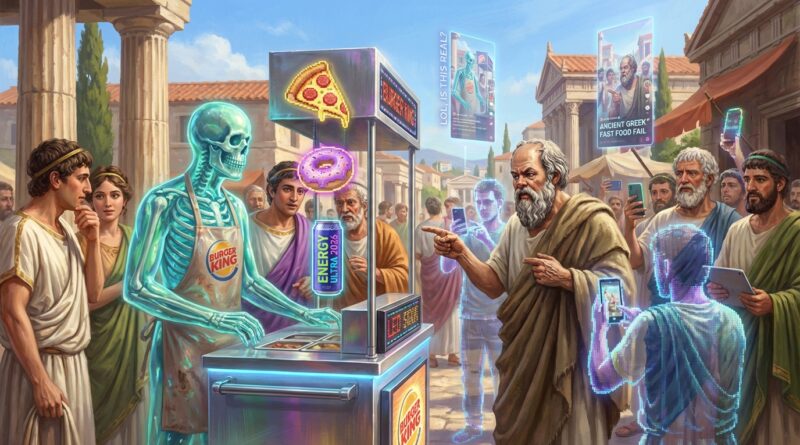
Inside the Socrates vs Skeleton AI Saga: How One Cursed Meme Took Over Reels Overnight
If your feed suddenly looks like a fever dream where a rattled skeleton is trying to sell pizza in ancient Greece and Socrates keeps dropping in to wreck the pitch, no, you did not miss a secret launch. You are watching one of those internet moments where a joke stops being a joke and turns into shared language almost overnight. That is why the Socrates skeleton AI meme explained question keeps popping up. People can tell this is not just random nonsense, even if it looks like nonsense at first glance. The frustration is real. Most explainers either wave it away as cheap AI spam or overthink it so hard they kill the joke. The better answer sits in the middle. This meme took off because it mixes three things people instantly get: dead-eyed AI visuals, anxious hustle culture, and an old philosopher acting like the world’s worst reply guy. Weirdly enough, that combo is very current.
⚡ In a Hurry? Key Takeaways
- The Socrates vs Skeleton trend blew up because it turns AI weirdness, gig-economy stress, and fake ancient-history roleplay into a simple repeatable joke.
- If you want to riff on it, keep the format but add a fresh conflict, character, or product instead of copying the same pizza setup beat for beat.
- This is a good early warning sign for future trends. When AI characters become mini recurring personalities, they often spread fast across TikTok, Reels, and Shorts.
What the meme actually is
At its core, this trend is a tiny piece of internet theater.
You usually get an AI-generated skeleton. He is stressed, trying to sell something, pitch something, or survive some impossible job in an ancient setting. Then Socrates appears, often as the smug truth-teller, the debate guy, or the person asking one question too many and ruining the sale.
That basic setup is enough to make endless versions.
Pizza in ancient Greece. Startup energy in a toga. Modern sales talk in a stone marketplace. A skeleton with the emotional state of a burned-out gig worker. Socrates acting like he invented comment-section pedantry.
It feels random, but it is not. It has structure.
Why this hit so hard
1. It turns AI mistakes into the joke
A lot of AI videos try to hide their weirdness. This one uses it.
The stiff faces, the cursed lip sync, the off-kilter backgrounds, the slightly wrong tone. Those are not bugs in this format. They are the punchline. The more the clip feels like a machine trying and failing to understand human drama, the funnier it gets.
That matters because people are tired of polished content. Sloppy AI visuals can feel cheap, sure. But when the cheapness becomes part of the comedy, viewers stop asking, “Why does this look wrong?” and start saying, “That wrongness is the bit.”
2. It captures modern work anxiety in one image
The skeleton is not just funny because he is a skeleton.
He is funny because he looks like everyone who has had to sell something they barely believe in. He is overextended. Underqualified. Weirdly upbeat in a way that suggests panic. He is trying to move product across time itself.
That lands because a lot of younger viewers already feel like they are roleplaying stability while the world gets stranger. The skeleton is basically burnout with ribs.
3. Socrates is the perfect villain for the moment
Socrates works because almost everybody understands his type even if they have never read a line of philosophy.
He is the guy who hears a normal pitch and responds with, “But what is pizza, really?” He is the human version of a reply thread that will not let the joke breathe. He turns every hustle into a debate club problem.
That makes him ideal meme fuel. He is smart, annoying, recognizable, and easy to parody.
4. It is micro-lore, not just a one-off gag
This is the part a lot of people miss.
The trend is sticking because it has recurring characters and rules. Once viewers understand the skeleton, the setting, and Socrates’ role, they can enjoy each new variation faster. There is no long setup needed. The audience already knows the world.
That is how “brainrot” becomes folklore. Tiny repeated details start doing the work of world-building.
Why it spread so fast across Reels, TikTok, and Shorts
Short-form platforms love anything that is easy to recognize in the first second and easy to remix by the tenth.
This meme checks both boxes.
The visual is immediate. A skeleton in ancient Greece is already enough to stop the scroll. Then the dialogue format kicks in. Conflict appears instantly. People know who the fool is, who the interrupter is, and where the joke is probably headed.
Creators also like trends that are cheap to copy. You do not need sets, actors, or a giant budget. You need a prompt style, a voice, and a basic script pattern. That low barrier helps a trend jump from one platform to another before anyone can label it dead.
So is this just “AI slop”?
Sometimes, yes. But that label is too blunt to explain why this specific meme worked.
Plenty of AI clips go nowhere. They are disposable because they have no character logic, no emotional hook, and no remix value. Socrates vs Skeleton has all three.
Calling everything AI-made “slop” is a little like calling every reality show “trash” and then wondering why some become cultural events anyway. You still have to ask why one format caught on and another did not.
Here, the answer is simple. The meme found a sweet spot between stupidity and recognition. It is dumb on purpose, but it is also readable. People see themselves in it, and they can add to it.
The secret formula behind the trend
If you are a creator or social media manager, this is the part to steal thoughtfully.
Character pairing
One anxious striver. One confident interrupter.
The best meme duos often work like comedy partnerships. One person wants something. The other person blocks, questions, or exposes the nonsense.
Time mismatch
Modern problems placed in the wrong era.
That mismatch does a lot of comic work fast. Sales funnels in the agora. Startup talk in sandals. Brand voice in a civilization built on olive oil and debate.
Low-stakes apocalypse energy
Everything feels urgent, but the subject is ridiculous.
That is a very online tone. The video acts like civilization depends on a pizza launch, which mirrors how the internet often treats tiny things as life-or-death content events.
Repeatable conflict
Every good version can be summed up in one sentence.
“A desperate ancient seller gets philosophically destroyed.” That is a real format, not just a random clip.
What it says about Gen Z humor right now
This trend is a mix of irony, exhaustion, and nostalgia for things nobody was actually nostalgic for five minutes ago.
Ancient Greece is not the point. It is just far enough away to make modern nonsense look fresh again. The skeleton adds doom. Socrates adds overthinking. The product pitch adds late-capitalist stress. Put them together and you get a joke about trying to function inside systems that already feel absurd.
That is why the meme feels bigger than its parts. It turns a vague mood into a portable little sketch.
How to riff on the trend without copying it badly
If you want to use this format, do not just remake the exact same video with slightly different wording. That is the fastest path to getting ignored.
Change the product
Pizza worked because it was hilariously out of place. Find another object or service that creates the same friction. Subscriptions. Energy drinks. Drop-shipping. Therapy apps. Loyalty programs.
Change the authority figure
Socrates is strong, but the larger pattern is “recognizable thinker or icon disrupts modern nonsense.” You can swap in other figures if the role still works.
Keep the emotional truth
The skeleton needs to feel like he desperately needs this to work. If that tension disappears, the joke falls flat.
Write one line people can quote
Trends last longer when a phrase escapes the original clip. Give viewers a sentence they can repeat in comments, captions, and duets.
How to spot the next AI micro-lore trend early
This is the real value in paying attention.
When weird AI clips start turning into recurring character worlds, you are no longer looking at isolated junk. You are looking at a possible format explosion.
Here is the simple framework:
Look for recurring roles
If the same type of character keeps showing up, that is a clue. Viewers like familiar personalities, even in absurd settings.
Look for remixable tension
A trend grows when anyone can plug in a new object, setting, or line and still keep the joke intact.
Look for comments that expand the world
Once people start asking for lore, backstory, rivalries, and sequels, the format has legs.
Look for cross-platform migration
If a joke leaves TikTok and starts showing up on Reels and Shorts with the same characters, it is becoming shared internet shorthand.
Why this matters more than it seems
It is easy to laugh this off. Fair enough. You probably should laugh. But it is also useful to notice what kind of nonsense survives.
The Socrates skeleton AI meme explained story is really about how online culture now builds itself. AI tools make image and voice generation cheap. Short-form apps reward repeatable hooks. Viewers reward characters they can recognize instantly. The result is fast-moving micro-lore that can appear dumb and still carry a real social mood.
Today it is a skeleton in Greece. Tomorrow it will be some other cursed pairing that captures a different anxiety.
At a Glance: Comparison
| Feature/Aspect | Details | Verdict |
|---|---|---|
| Why it went viral | Combines cursed AI visuals, easy-to-read characters, and a repeatable conflict people can remix fast. | More than random spam. It has a real meme engine. |
| What viewers connect with | The skeleton feels like burnout and hustle culture. Socrates feels like relentless online correction culture. | It works because the emotions are familiar, even if the setting is ridiculous. |
| What creators should do | Use the format’s logic, not the exact script. Swap the product, pressure, or historical figure to make it fresh. | Best used as a template for new jokes, not a photocopy machine. |
Conclusion
If your instinct was “this is stupid, but also weirdly telling,” you were right on both counts. This helps the community today because the Socrates vs Skeleton saga is moving fast from random brainrot to a shared reference point across TikTok, Reels and Shorts. Once you see why this mix of AI art, ancient philosophy, and time-travel capitalism hit so hard, you can spot the next wave of AI-driven micro-lore before it clogs your feed. Better yet, if you make content, you can riff on the trend without lazily cloning it. That matters. The smartest way to read memes now is not just asking whether they are good or bad. It is asking what social mood they are packaging, and why people want to repeat it.