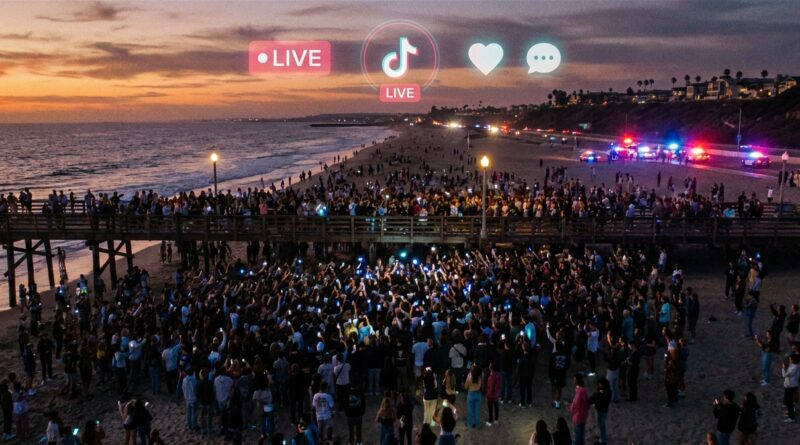
Inside TikTok’s ‘TikTok Takeover’ Beach Flash Mobs: How One Viral Call-To-Show-Up Just Redefined What A Party Protest Looks Like
If your feed suddenly looks like the same beach panic clip on repeat, you are not imagining it. One minute it is kids dancing on the sand and posting meetup videos. The next, there are police lights, blocked roads, and local residents asking how a normal beach night turned into a crowd-control problem. That confusion is the real story behind the TikTok Takeover Newport Beach trend. Most clips show the chaos, but not the mechanics. What started as a viral call to show up became a real-world swarm event, powered by reposts, group chats, algorithm boosts, and the social pressure of not wanting to miss the moment. For parents, locals, and even teens watching from home, the big question is not just “what happened?” It is “what kind of internet behavior is this becoming?” Newport Beach gave us a clear answer. This is no longer just clout. It is social media organizing, stripped of permits, leaders, and brakes.
⚡ In a Hurry? Key Takeaways
- The TikTok Takeover Newport Beach trend was not just a party invite. It acted like a flash-mob trigger that pulled a huge youth crowd into one public space fast.
- If you see vague “pull up” videos, location tags, countdown posts, and mass reposts across TikTok, Snapchat, and Instagram, treat that as an early warning sign, not harmless hype.
- These events can shift from fun to dangerous in minutes, which is why cities, police, platforms, and parents are now reacting much faster.
What a “TikTok Takeover” actually means
At the simplest level, a TikTok Takeover is a mass meetup built through short-form video culture. Someone posts a call to show up at a beach, mall, boardwalk, park, or neighborhood spot. The post uses urgency, humor, and a feeling that “everybody” will be there.
Then the internet does what it does best. It copies. It remixes. It spreads. One original invite turns into stitched videos, reaction clips, screenshots, reposts to Stories, and private messages. By the time adults hear about it, the crowd may already be on the move.
What makes this different from the old-school flash mob is that it is less organized and more algorithmic. There may be no official host. No permits. No plan for bathrooms, traffic, fights, or emergency access. But there is still a powerful social engine behind it.
Why Newport Beach became the perfect case study
Newport Beach checks a lot of boxes for this kind of event. It is visually recognizable, easy to tag, attractive on camera, and already part of youth culture online. A beach location also creates a false sense of endless space. On video, it looks like there is room for everyone. In real life, roads choke, parking fills, and exits become bottlenecks fast.
That is why the TikTok Takeover Newport Beach trend matters beyond one city. Newport was not random. It was almost designed for virality. The beach is a backdrop, the crowd is the content, and the turnout becomes proof that the invite “worked.”
How one viral call turns into offline chaos
Step 1: The invite stays vague on purpose
These posts usually do not read like formal event announcements. They are often loose, jokey, and open-ended. “Pull up.” “Don’t miss this.” “Everyone at Newport tonight.” That vagueness helps the post travel. It also gives the original poster room to back away later and say it was “just for fun.”
Step 2: The algorithm rewards momentum
Once enough people comment, save, repost, or argue in the comments, the post gains heat. TikTok does not need a polished campaign to spread something. It just needs engagement. The more people ask “is this real?” the more real it becomes.
Step 3: Private channels do the heavy lifting
Public TikToks create awareness. Private group chats create attendance. That handoff is important. Snapchat, Instagram DMs, text threads, and Discord servers often turn a viral idea into an actual crowd with a meeting point and time.
Step 4: The crowd becomes its own advertisement
Once the first wave arrives, people post live footage. That creates the strongest signal of all. Not a promise. Proof. Suddenly, anyone nearby can see that the event is already happening, which pulls in more people who were undecided.
Step 5: Systems built for normal weekends get overwhelmed
Police, lifeguards, parking staff, local businesses, and residents are usually prepared for busy days, not sudden swarm behavior. When a crowd forms without clear leadership, even small incidents can spread fast. A rumor of a fight. A loud bang. Someone running. One panic pocket can ripple through a whole beach area.
So was this a protest, a party, or something new?
That is where things get interesting. A TikTok Takeover is usually advertised as a party. But in practice, it can act like a protest without formal politics. It occupies space. It overwhelms normal rules. It sends a message that young people can claim a location simply by appearing in large numbers.
This is why the phrase “party protest” makes sense. Not because every attendee has a cause, but because the event itself tests who gets to use public space, under what rules, and with whose permission.
For a lot of Gen Z and Gen Alpha users, showing up is the statement. The crowd is the message. Adults often look for leaders and demands. These events often have neither. They are more like networked demonstrations of presence.
What Newport Beach tells us about Gen Z and Gen Alpha behavior
There is a common mistake older observers make. They assume this is all random teenage chaos. It is not random. It is loosely coordinated behavior shaped by platform design.
Younger users are very good at reading social cues online. They know how to spot momentum, how to jump in before a trend peaks, and how to turn attendance into social capital. Going to the event is one layer. Posting that you were there is another. Being early, visible, and funny about it adds even more status.
That does not mean every participant wants trouble. Most probably do not. But a large, leaderless crowd only needs a small number of reckless people, plus one tense moment, to change the entire mood.
Why local officials are taking these events more seriously now
After incidents like Newport Beach, cities do not see “just kids hanging out.” They see a fast-scaling public safety problem. From their point of view, a takeover can affect emergency response routes, nearby businesses, traffic flow, property damage, transit, and neighborhood safety all at once.
That usually leads to a predictable response cycle.
First comes policing
More officers. More monitoring of public posts. Faster crowd dispersal tactics. In some places, temporary restrictions around parking or beach access follow.
Then comes policy
City councils and school districts start talking about curfews, event rules, trespassing enforcement, and consequences for organizers or promoters.
Then comes platform pressure
If enough news coverage builds, social platforms may remove location-specific meetup posts, throttle discoverability, or respond to law enforcement requests more quickly.
That backlash matters because the format is evolving. The more visible these events become, the more institutions try to get ahead of them.
How to read the warning signs in your own feed
You do not need to be a digital detective to spot a possible takeover forming. Look for patterns, not one single video.
Watch for repeated location tags
If the same beach, mall, or park keeps appearing in short clips with “tonight,” “everybody pull up,” or countdown language, pay attention.
Notice when details are oddly fuzzy
Vagueness is a feature, not a bug. A post that avoids specifics can spread more easily and sidestep responsibility.
Check the comments
Comments often reveal whether people are joking, planning, asking for exact spots, or sharing side-channel info.
Look beyond TikTok
If the same meetup is leaking into Snapchat Stories, Instagram reposts, and local group chats, the chance of real turnout goes up a lot.
Pay attention to “proof of life” posts
The moment people start posting that they are already there, the event shifts from rumor to active magnet.
What parents, residents, and local businesses should do
You do not need to panic, but you do need to stop treating these as harmless internet noise.
For parents
Ask simple questions. Where is it? Who is hosting it? How are you getting home? What happens if phones die or the crowd turns? Teens are more likely to respond well to practical safety talk than a lecture about social media being bad.
For residents
If your area starts circulating in takeover posts, expect traffic and crowd pressure before official alerts arrive. Move cars if needed. Avoid getting trapped near access roads. Follow city updates instead of relying on rumor clips.
For businesses
Have a quick plan for crowd surges, staff exits, and early closure if conditions feel off. Viral attendance can look good from a distance, but unplanned masses are not the same as healthy foot traffic.
What this says about public space in 2026
The deeper issue here is not just TikTok. It is that social media now acts like a rapid-deployment tool for physical gathering. That changes the meaning of public space.
A beach used to get busy because of weather, holidays, or scheduled events. Now it can get overwhelmed because a recommendation system nudged the right video to the right cluster of bored teenagers at the right hour.
That is a big shift. It means civic spaces are increasingly affected by platform behavior, not just city planning. The app is no longer separate from the street. It helps program the street.
Is this trend likely to spread?
Yes, because the formula is simple and repeatable. Pick a known location. Use vague hype. Let reposts build momentum. Turn attendance into content. Repeat.
And once a place like Newport Beach gets associated with a successful takeover, copycats appear. Other towns start seeing similar invites. Some will fizzle. Some will blow up. The hard part is that nobody can fully predict which one becomes the next real-world swarm.
At a Glance: Comparison
| Feature/Aspect | Details | Verdict |
|---|---|---|
| How it starts | A viral “pull up” style post spreads through TikTok, then moves into private chats and repost networks. | Looks casual online, but can mobilize a serious crowd offline. |
| What it feels like | Part beach party, part status event, part occupation of public space by sheer numbers. | Not a formal protest, but more than simple clout-chasing. |
| Why it matters | Crowds can overwhelm roads, businesses, emergency access, and local policing within minutes. | A real public-safety and policy issue, not just a social media fad. |
Conclusion
The reason to pay attention to the TikTok Takeover Newport Beach trend is not to moralize about kids on phones. It is to understand a new kind of real-world coordination. A short video can now function like a crowd switch. Flip it, and a quiet public space can become unmanageable fast. That helps explain why Newport Beach escalated the way it did, and why the response after it was so intense. If you know how to read the signals in your feed, you get a head start. You can tell the difference between a harmless meetup and a high-impact swarm event before the official headlines catch up. That matters for parents, residents, businesses, and local leaders. It also tells us something bigger about 2026. Youth culture is not staying on the screen. It is showing up, in numbers, and forcing cities to figure out what happens when the algorithm throws a party in real life.