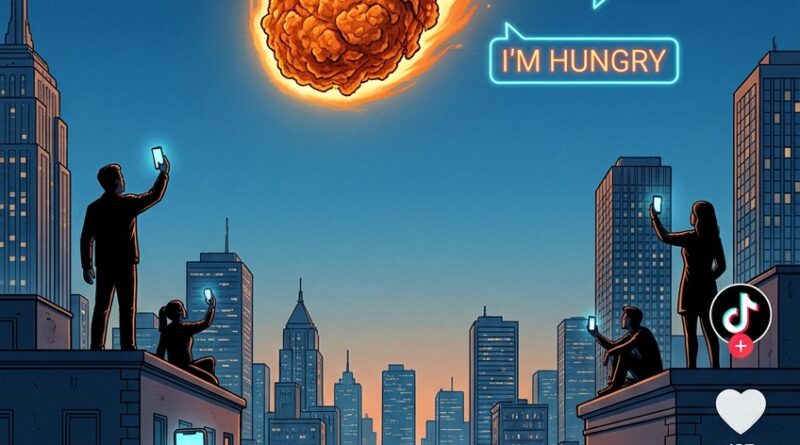
Inside TikTok’s ‘Meteor Or Fried Chicken?’ Freak‑Out: How One Sky Clip Just Became The Internet’s New Favorite Reality Glitch
You are not imagining it. One minute you are casually scrolling, and the next your feed is full of the same blurry sky clip, with half the comments yelling “meteor” and the other half saying it looks exactly like a flying drumstick. That kind of internet whiplash is weirdly exhausting. You are trying to figure out whether you missed an actual event, whether everyone is joking, or whether TikTok has simply decided this is the thing we all have to care about today. The short answer is that the video became bigger than the object in it. Whether it was a meteor, debris, lens weirdness, or just a clip with perfect comedy timing, the real story is how fast uncertainty turns into entertainment. People are not only watching the video. They are watching each other react to it, argue about it, remix it, and turn confusion itself into the main event.
⚡ In a Hurry? Key Takeaways
- The viral meteor fried chicken TikTok video spread because nobody could agree on what they were seeing, and that disagreement became the content.
- If you want to tell whether a clip is real, start by checking the original upload, location details, repost timing, and whether any trusted local sources mention the same event.
- These viral “reality glitch” moments are usually harmless fun, but they also show how quickly speculation can outrun facts and shape what everyone talks about.
What actually happened with the viral meteor fried chicken TikTok video?
A short sky video hit TikTok and immediately split viewers into camps. One group saw a meteor or some kind of object streaking through the sky. Another group saw something much sillier. To them, it looked like a floating piece of fried chicken, or at least something breaded and oddly snack-like.
That sounds ridiculous, which is exactly why it worked. The clip had three things the internet loves. It was short. It was unclear. It was funny without needing setup.
Once that happens, the original question stops being the only question. People are no longer asking, “What is this?” They are also asking, “Which side are you on?” That turns a random clip into a social game.
Why this kind of video takes over your feed so fast
Confusion is shareable
Clear videos can go viral, sure. But confusing videos have a special kind of power. They invite participation. If a clip obviously shows a meteor, there is not much to debate. If it kind of looks like a meteor, kind of looks like lunch, and kind of looks like bad camera compression, now everybody wants in.
Comments become the entertainment layer. Duets and stitches pile on. Soon the clip is less about the sky and more about the crowd.
The algorithm loves a split room
TikTok is very good at noticing when people stop, replay, comment, and send a clip to friends with “What am I even looking at?” That is high-value engagement. A video that makes people argue politely, joke loudly, and watch twice can travel farther than a video that is simply informative.
That is why the viral meteor fried chicken TikTok video feels unavoidable once it catches. The system sees confusion as interest, and interest as a reason to keep pushing it.
Absurdity lowers the barrier to entry
You do not need to be a space expert to join this conversation. You just need eyeballs and an opinion. Maybe not even a strong opinion. Even “I hate that I can see the chicken” is enough to participate.
That matters. The easier it is for millions of people to jump in, the faster a meme forms.
So was it a meteor?
Maybe. Maybe not. And that is part of the point.
In a lot of these viral moments, the answer stays fuzzy far longer than people expect. The source clip may be low quality. The location may be unclear. Reposts may strip out the original caption. People may add dramatic music, zooms, and edits that make the object look stranger than it did at first.
If no credible local report, astronomy update, or news source confirms a visible event in that place and time, you should treat the clip as unverified entertainment first, evidence second.
That does not mean it is fake. It just means the internet is very good at making uncertainty feel official.
How to tell if a viral sky clip is worth taking seriously
1. Find the earliest version you can
Look for the original uploader, not the fiftieth repost with a caption in all caps. The first upload often has useful details like location, time, or a calmer explanation before the meme machine took over.
2. Check whether anyone local saw it too
If something bright streaked across the sky, local Facebook groups, community apps, weather watchers, or regional news outlets usually mention it pretty quickly. A real sky event often leaves a small trail of witnesses.
3. Watch for compression and perspective tricks
Phone cameras do strange things with bright objects, fast movement, zoom, and low light. A tiny distant object can look huge. A blur can gain a funny shape. Compression can turn a streak into a nugget with wings.
4. Separate jokes from claims
Comments are not evidence. They are often performance. Once the “fried chicken” line lands, thousands of people will repeat it because it is funny, not because they believe airborne takeout is a real atmospheric category.
5. See whether experts are saying anything concrete
If it really was a meteor, astronomy accounts, observatories, or local science groups may have something useful to say. If they are silent, that does not prove the clip is fake. It just means the crowd may be running ahead of the facts.
Why this feels like a “reality glitch”
The phrase fits because these clips create a brief shared sensation that reality itself has become slippery. You are seeing one thing. Other people are seeing something totally different. Both sides sound weirdly confident. The joke and the fact-check are happening at the same time.
That mix is perfect for modern internet culture. We no longer wait for a clean answer before making the moment social. We do the opposite. We turn the uncertainty into the event.
It is a little chaotic, but it also tells you a lot about how online attention works now. The thing that spreads is not always the most important event. It is often the event that creates the most usable confusion.
What this says about culture now
A random sky clip can become the center of the internet for a day because attention is no longer just about importance. It is about emotional usability. Can people joke with it? Can they argue about it? Can they turn it into identity for five minutes?
That is why the viral meteor fried chicken TikTok video matters beyond the laugh. It is a tiny case study in how culture is built at high speed now. The crowd does not just react to media. The crowd finishes it.
Every comment, stitch, parody, and “be serious, that is clearly chicken” reply becomes part of the object’s meaning.
How to spot the next “reality glitch” meme early
Look for low-clarity, high-confidence content
If a video is blurry but the caption is dramatic, that is a strong sign. The less certain the footage, the more room there is for collective invention.
Watch for instant camp formation
When comments divide into clean teams almost immediately, a meme is forming. Team meteor. Team fried chicken. Team “it is obviously a bug on the lens.” Once sides appear, sharing accelerates.
Notice when remixes overtake the original
The moment parody versions, reaction videos, and edits start outperforming the source clip, the story has moved from event to culture. That is usually the point where the meme escapes its original context and becomes feed-wide.
Pay attention to how you found it
If you saw it through a reaction, then a joke, then a “debunk,” and only later saw the original, you are watching the modern viral pipeline in reverse. That is common now.
Should you care, or just laugh and move on?
Honestly, both are fine.
You do not need to treat every viral mystery like a full investigation. Sometimes the right response is just to laugh at the fact that millions of people agreed a sky object looked breaded. But it is also useful to notice the mechanics underneath the joke.
These moments train us to treat volume as truth. The more often you see a clip, the more real and important it can feel, even when the actual evidence has not improved at all.
That is the practical lesson here. Enjoy the meme. Just do not let repetition trick you into certainty.
At a Glance: Comparison
| Feature/Aspect | Details | Verdict |
|---|---|---|
| What made it viral | A short, unclear sky clip that sparked a funny split between “meteor” and “fried chicken” viewers | Classic high-engagement meme fuel |
| How to verify it | Check the original source, date, location, witness reports, and any credible science or local news confirmation | Useful before treating it as fact |
| What it really shows us | Confusion, humor, and crowd reaction now shape what becomes a shared cultural moment | Bigger than the clip itself |
Conclusion
The funniest part of the viral meteor fried chicken TikTok video is not just that people saw a cosmic event and a fast-food item in the same frame. It is that both reactions helped make the clip matter. That is why this is worth paying attention to. It is not just another recap of a weird video. It is a live example of how confusion and low-key absurdity now drive culture in a single day. Once you see that pattern, your feed starts making a lot more sense. You get better at separating signal from noise, spotting when crowd speculation is doing the heavy lifting, and catching the next “reality glitch” meme while it is still forming instead of after the joke has already gone stale.